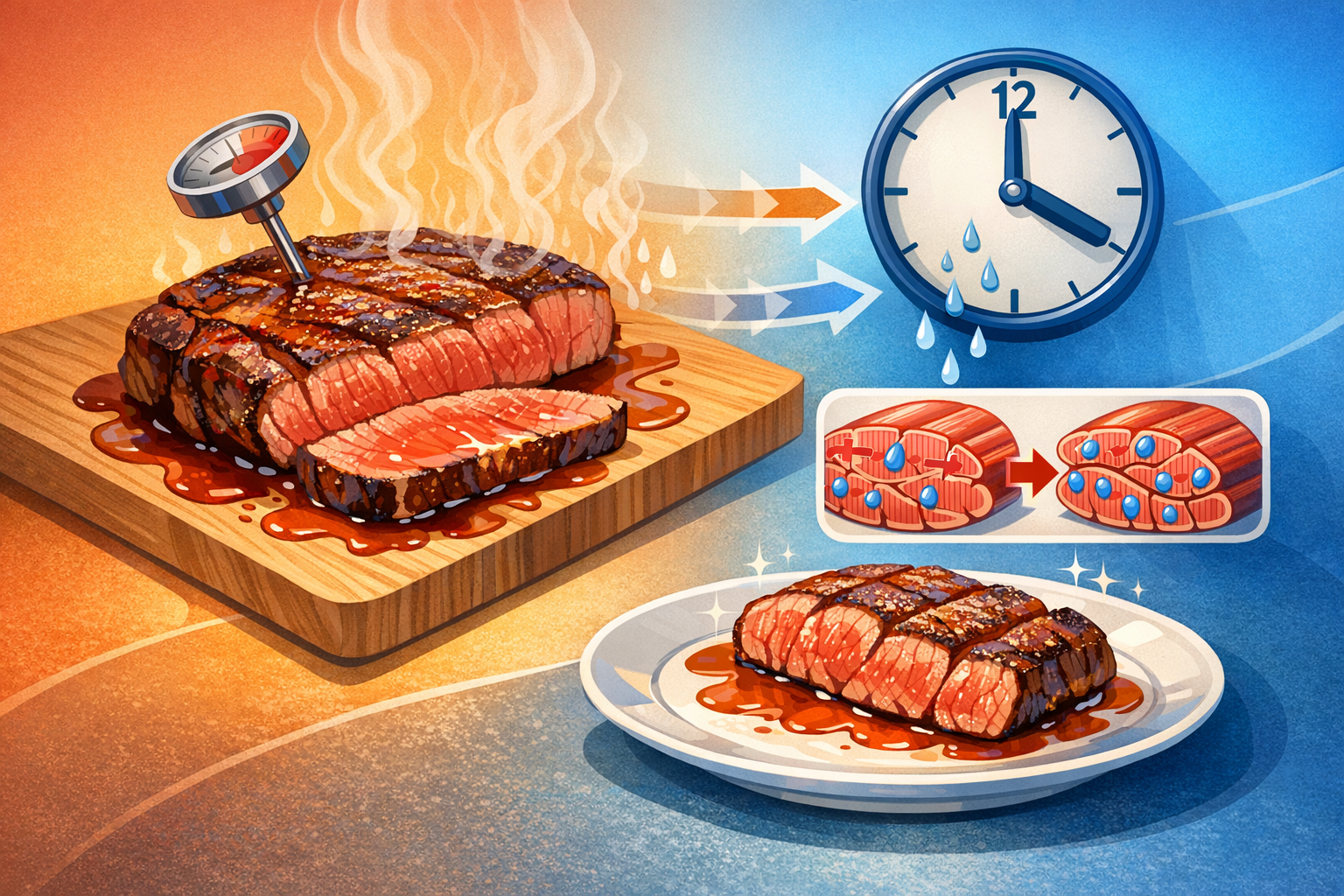
You've just pulled a beautifully seared steak off the grill. The crust is perfect, the internal temperature reads exactly 130°F, and the aroma is incredible. Every instinct tells you to cut into it immediately. But if you do, you'll watch helplessly as a pool of red liquid floods your cutting board, leaving you with a steak that's noticeably drier than it should be.
This scenario plays out in kitchens every day, and the solution is deceptively simple: let the meat rest. It's one of the most frequently repeated pieces of cooking advice, yet it's also one of the least understood. Most people know they should rest meat, but few can explain why it works, how long to rest, or what's actually happening inside that steak during those crucial minutes on the cutting board.
The answer involves protein chemistry, thermodynamics, and fluid mechanics. Understanding these forces will change the way you think about cooking meat.
What Happens to Meat During Cooking
To understand why resting works, you first need to understand what heat does to meat at a structural level.
Meat is primarily composed of water (about 75% by weight), protein (about 20%), and fat (varying amounts depending on the cut). The protein exists in two main forms: myosin and actin, the two proteins responsible for muscle contraction. In raw meat, these proteins are loosely coiled and surrounded by water.
As meat heats up, the proteins undergo a process called denaturation. They uncoil and then re-bond with each other in new configurations, forming a tighter, more rigid structure. Think of it like wringing out a sponge: as the protein network contracts, it squeezes out the water that was trapped between the fibers.
This process happens at specific temperature thresholds. Myosin begins denaturing at around 104°F (40°C) and is fully denatured by 122°F (50°C). At these temperatures, the protein contraction is modest and the meat actually becomes more tender as the collagen begins to soften. Actin begins denaturing at approximately 150°F (66°C), and this is where things get critical. Actin denaturation causes a much more aggressive contraction of the muscle fibers, squeezing out significantly more moisture. This is why a steak cooked to 160°F (well done) loses roughly 25% more liquid than one cooked to 130°F (medium-rare).
The Temperature Gradient Problem
When you cook meat using high heat (grilling, searing, roasting), you create a steep temperature gradient between the exterior and the interior. The outer layers may be 400°F or higher at the surface, while the center might only be 125°F. Between these extremes, every layer of the meat is at a different temperature.
This gradient has a direct impact on moisture distribution. The outer layers, having reached higher temperatures, have experienced more protein contraction. Their fibers are tightly clenched, and much of the water that was once held in these outer zones has been squeezed toward the center of the meat, where the proteins are less denatured and the fiber structure is still relatively loose.
The result, immediately after cooking, is a piece of meat with an uneven moisture distribution: the center is gorged with liquid that has been pushed inward from the contracting outer layers, while the exterior is comparatively dry.
The Resting Period: Redistribution in Action
When you remove meat from the heat source and let it rest, two processes begin simultaneously: temperature equalization and moisture redistribution.
Temperature Equalization
Heat always flows from warmer areas to cooler ones. During resting, the scorching outer layers transfer their heat inward while cooling down. The center temperature actually continues to rise, a phenomenon called carryover cooking. In a thick steak, carryover can add 5 to 10 degrees to the center temperature. In a large roast, it can add 10 to 15 degrees or more.
This is why experienced cooks pull meat from the heat source before it reaches its target temperature. A steak destined for medium-rare (130°F) should come off the grill at 120-125°F, allowing carryover to do the rest.
As the temperature gradient flattens, the outer protein fibers begin to relax slightly. They don't fully unclench (denaturation is permanent), but the reduction in thermal energy allows them to loosen just enough to reabsorb some moisture.
Moisture Redistribution
This is the main event. As the temperature equalizes, the uneven moisture distribution begins to correct itself. The water pooled in the center migrates back outward toward the drier exterior, redistributing through the meat more evenly.
The driving force behind this redistribution is a combination of pressure equalization and capillary action. The tightly contracted outer fibers, now slightly relaxed, create small channels that draw moisture back through the protein network. Simultaneously, the reduction in temperature-driven contraction releases some of the mechanical pressure that was pushing water inward.
The difference is measurable. Food scientist Harold McGee conducted experiments showing that a steak cut immediately after cooking loses about 22% more juice than one rested for five minutes. J. Kenji López-Alt at Serious Eats replicated these findings, demonstrating that a rested steak can retain up to 9% more moisture by weight than an unrested one. For an eight-ounce steak, that's roughly a tablespoon and a half of additional liquid remaining in the meat rather than on your plate.
How Long to Rest: Guidelines by Cut and Size
The ideal resting time depends primarily on the thickness and mass of the meat. Thicker, larger cuts have steeper temperature gradients and more uneven moisture distribution, so they need more time.
Steaks (1 to 1.5 inches thick)
Rest for 5 to 7 minutes. This is enough time for the temperature to equalize across the relatively thin cross-section. Place the steak on a warm plate or cutting board. There's no need to tent it with foil for cuts this size; the brief resting period won't result in significant heat loss.
Thick-Cut Steaks and Small Roasts (1.5 to 3 inches)
Rest for 10 to 15 minutes. Tomahawk steaks, beef tenderloin, pork tenderloins, and rack of lamb all fall into this category. You can tent loosely with foil if your kitchen is cold, but don't wrap tightly or you'll steam the crust you worked so hard to create.
Large Roasts (Prime Rib, Whole Chicken, Turkey)
Rest for 15 to 30 minutes, depending on size. A 10-pound prime rib roast benefits from a full 30-minute rest. The thermal mass of a large roast means carryover cooking is substantial (often 10-15°F), and the moisture redistribution takes longer because the water has further to travel.
A whole turkey should rest for at least 20 minutes, and 30 to 45 minutes is even better for a large bird. The good news: a 15-pound turkey retains heat well enough that it will still be plenty hot after 45 minutes of resting. This is also the perfect window for making gravy, reheating side dishes, and getting everything else to the table.
The Overcooking Risk
Some cooks worry that resting will result in cold food. For steaks and small cuts, a five to seven minute rest drops the surface temperature by only 10-15°F, which is barely noticeable on the palate. For large roasts, the insulating mass of the meat keeps the interior hot for a surprisingly long time.
The greater risk is not resting long enough. An impatient cut into a thick roast after only five minutes will still result in significant juice loss, because the temperature gradient hasn't had time to equalize through the full depth of the meat.
Beyond Resting: Other Factors That Affect Juiciness
Resting is critical, but it works best as part of a comprehensive approach to moisture retention.
Brining and Salting
Salting meat ahead of time (dry brining) or soaking it in a salt solution (wet brining) increases its moisture-holding capacity. Salt dissolves some of the myosin proteins, which then form a gel that traps water more effectively during cooking. A properly brined chicken breast can retain 10-15% more moisture than an unbrined one.
Dry brining (rubbing salt on the surface 1-24 hours before cooking) is simpler and equally effective for most applications. The salt initially draws moisture to the surface through osmosis, then the concentrated brine is reabsorbed into the meat, carrying the salt deep into the muscle fibers. This process both seasons the meat throughout and restructures the proteins for better water retention.
Don't Overcook
This sounds obvious, but it's the single biggest factor in dry meat. The difference in moisture loss between a steak cooked to 130°F and one cooked to 160°F is dramatic: roughly 50% more juice lost at the higher temperature. Using an instant-read thermometer and pulling meat at the right time makes a bigger difference than any other technique.
Cooking Method Matters
Reverse searing (cooking at low temperature first, then finishing with a high-heat sear) produces a more even internal temperature gradient than traditional searing. This means less moisture is displaced toward the center during cooking, and the redistribution during resting is faster and more complete.
The reverse sear is particularly effective for thick steaks (1.5 inches or more) and roasts. Start in a 250°F oven until the center reaches 10-15°F below your target temperature, then sear in a blazing-hot cast iron pan for 60-90 seconds per side. The result is edge-to-edge even doneness with a great crust, and the meat needs less resting time because the gradient was never as extreme.
Cutting Against the Grain
How you slice rested meat matters enormously. Muscle fibers run in parallel bundles (the "grain"), and cutting parallel to these fibers means you're essentially creating long tubes of muscle that you then have to bite through. Cutting perpendicular to the grain (against the grain) slices these tubes into short segments, so each bite requires far less chewing force and releases its juices more readily on the palate.
To identify the grain, look for the parallel lines running through the meat. In some cuts, like flank steak and brisket, the grain is very pronounced and easy to see. In others, like tenderloin, the grain is subtle. When in doubt, make a small test cut and look at the cross-section: if you see long fibers, rotate 90 degrees.
The Proof Is on the Plate
Skeptical cooks can easily verify resting's impact at home. Buy two identical steaks. Cook them both to exactly the same internal temperature using a thermometer. Cut one immediately and the other after a five-minute rest. Place each on a separate white plate.
The difference will be visible within seconds. The immediately-cut steak will release a pool of liquid onto the plate, while the rested steak will release very little. Taste both, and the rested steak will be noticeably juicier and more evenly cooked throughout.
This simple experiment converts skeptics more effectively than any amount of scientific explanation. The evidence is right there on the plate, in the juice that stayed in your steak instead of running out onto the cutting board.
Resting meat requires no special equipment, no additional ingredients, and no advanced technique. It only requires patience, and a willingness to trust the physics. Those five to fifteen minutes of waiting are the easiest way to dramatically improve every piece of meat you cook.