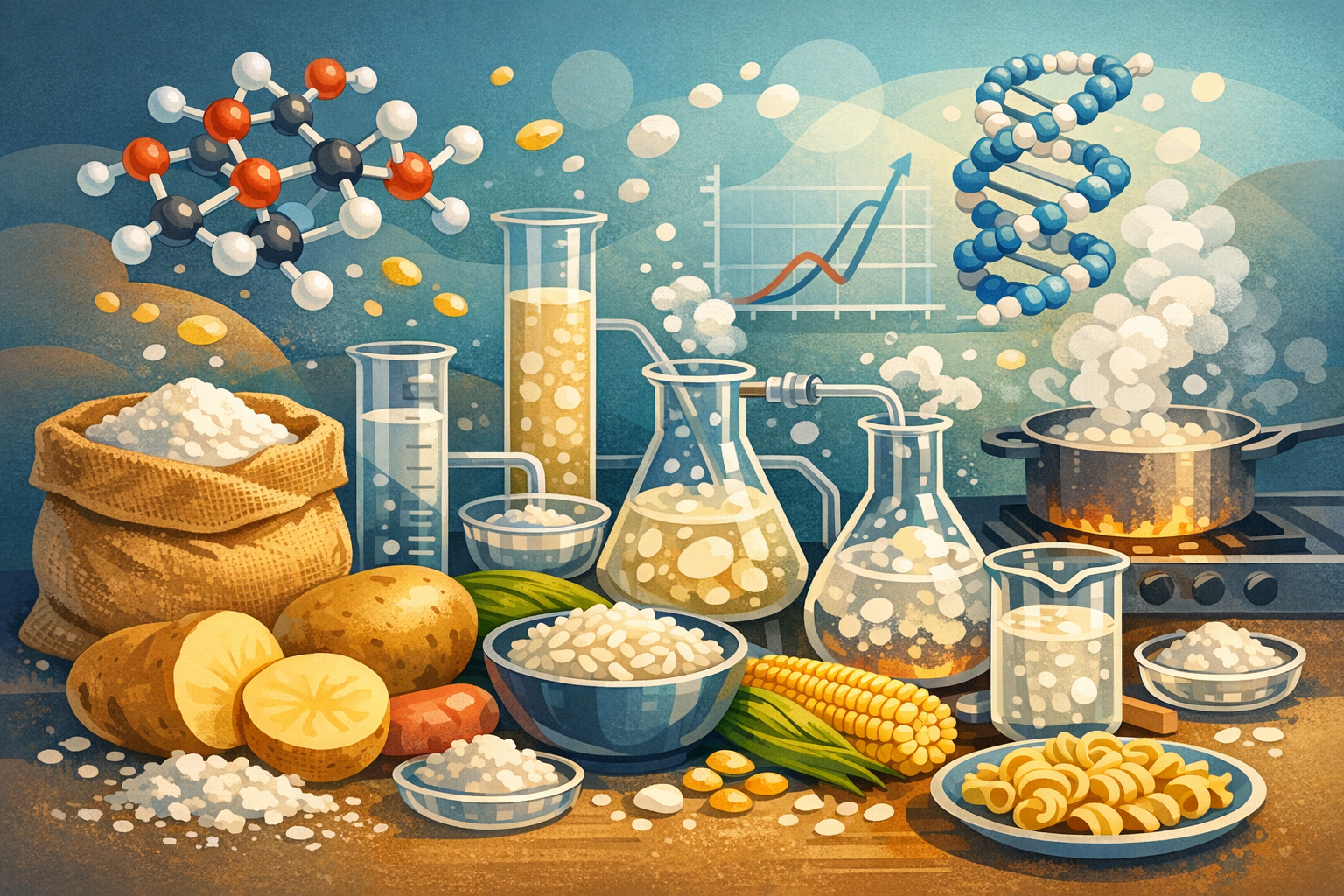
Starch is arguably the most versatile molecule in your kitchen, yet most cooks barely give it a second thought. It's the reason a roux thickens gumbo. It's why pasta water can transform a thin sauce into something silky. It's the force behind crispy fried chicken, fluffy mashed potatoes, and the satisfying chew of a good loaf of bread. Every time you boil, bake, fry, or simmer a starchy food, you're orchestrating a set of molecular transformations that determine whether your dish succeeds or fails.
Understanding starch, even at a basic level, answers some of the most persistent kitchen questions. Why does my gravy get thin when I add acid? Why does cornstarch work differently from flour? Why are my mashed potatoes gluey? The answers all trace back to the behavior of two molecules and how they respond to heat, water, and mechanical force.
Two Molecules, Infinite Possibilities
All starch is made of just two types of molecules, both built from chains of glucose (simple sugar). The difference between them explains almost everything about how starch behaves in cooking.
Amylose is a long, straight chain. Picture a piece of uncooked spaghetti. These straight chains pack together tightly, which makes high-amylose starches (like potatoes and long-grain rice) firm and somewhat resistant to dissolving. When they do dissolve in hot water, amylose molecules create clear, firm gels as they cool. Cornstarch is high in amylose, which is why cornstarch-thickened sauces set up glossy and translucent.
Amylopectin is heavily branched, like a tree. These branched molecules can't pack together neatly, so they dissolve more easily and create softer, more clingy textures. Waxy corn starch, tapioca, and glutinous rice are high in amylopectin. Sauces thickened with these starches stay soft and don't firm up as much when cooled.
Different starchy foods contain different ratios of these two molecules, and that ratio determines their cooking properties. A russet potato (about 20 percent amylose) behaves very differently from a waxy red potato (about 15 percent amylose), even though the total starch content is similar.
Gelatinization: The Main Event
The most important thing starch does in cooking is gelatinize. This is the technical term for what happens when starch granules absorb water and swell in the presence of heat. It's the reason raw flour tastes chalky and has no thickening power, while cooked flour creates smooth sauces.
Here's the process in detail: starch granules in their raw state are tightly packed crystalline structures. The amylose and amylopectin chains are held together by hydrogen bonds, and water can't easily penetrate. As you heat starch in water, the granules begin to absorb water and swell. This starts around 140°F (60°C) for most starches and completes between 160 and 185°F (71 to 85°C), depending on the type.
As the granules swell, they take up more and more space in the liquid. The amylose molecules begin leaching out of the swollen granules into the surrounding water. This combination of swollen granules and dissolved amylose is what creates the thick, viscous texture we associate with gravy, pudding, and cream sauces.
Different starches gelatinize at different temperatures:
- Cornstarch: 144 to 162°F (62 to 72°C)
- Wheat flour: 136 to 150°F (58 to 65°C)
- Potato starch: 136 to 150°F (58 to 65°C)
- Tapioca: 126 to 150°F (52 to 65°C)
- Rice starch: 154 to 172°F (68 to 78°C)
These temperature differences matter. Tapioca starts thickening at a lower temperature than cornstarch, which makes it useful in slow-cooker recipes where the temperature never reaches a full boil. Rice starch needs more heat, which is partly why rice takes longer to cook than pasta.
Flour vs. Cornstarch vs. Everything Else
Every cook eventually faces the question: which starch should I use to thicken this sauce? The answer depends on what you want the final product to look and taste like.
Wheat Flour
Flour is the workhorse thickener of French and American cooking. It contains about 75 percent starch and 10 to 12 percent protein (gluten). The protein content means flour-thickened sauces are opaque and have a matte finish. Flour must be cooked for at least 2 to 3 minutes after thickening to eliminate the raw, chalky taste.
Flour is almost always used in the form of a roux (equal parts flour and fat, cooked together) or a slurry (flour whisked into cold liquid). The fat in a roux coats the starch granules and prevents them from clumping when liquid is added. This is why dumping raw flour directly into a hot liquid creates lumps: the granules on the surface gelatinize instantly and form a waterproof shell that prevents water from reaching the starch inside.
A roux can be white (cooked 2 to 3 minutes), blond (5 to 7 minutes), or dark brown (20 to 45 minutes). As the roux cooks longer, the starch granules break down progressively, which means a dark roux has significantly less thickening power than a white roux. A dark Cajun roux made for gumbo adds incredible nutty, toasty flavor but thickens about one-third as effectively as the same quantity of white roux. This is why gumbo recipes call for such a large amount of roux.
Cornstarch
Cornstarch is pure starch with no protein, which means it produces clear, glossy sauces. It has roughly twice the thickening power of flour by weight. Cornstarch is the standard thickener in Chinese cooking for exactly this reason: stir-fry sauces should be translucent and shiny, not opaque and matte.
Cornstarch must be mixed with cold liquid (a slurry) before adding to hot food. Like flour, adding it directly to hot liquid causes immediate surface gelatinization and lumps. Unlike flour, cornstarch doesn't need extended cooking to remove a raw taste. Once the sauce returns to a simmer after adding the slurry, the cornstarch flavor is fully cooked out.
The main weakness of cornstarch: it doesn't hold up well to prolonged cooking or reheating. The swollen starch granules eventually rupture with extended heat and agitation, releasing their contents and thinning the sauce. This is called "thinning out" or starch breakdown, and it's why cornstarch-thickened sauces that are perfect at dinner can turn watery when reheated the next day. For dishes that will be reheated, flour or a root starch (arrowroot, tapioca) is a better choice.
Potato Starch
Potato starch is a pure starch like cornstarch but with different properties. It creates a light, almost ethereal thickness and an extremely clear gel. It also has more thickening power per tablespoon than cornstarch. The downside is that it's even more fragile than cornstarch. It breaks down quickly with extended cooking, so it's best added at the very end of cooking.
In Eastern European and Scandinavian cooking, potato starch is the traditional thickener for fruit soups and dessert sauces because of its crystal-clear finish. It's also the starch of choice for coating proteins before frying in Korean cooking (think crispy Korean fried chicken), where it creates a lighter, crunchier coating than wheat flour.
Tapioca
Tapioca comes from the cassava root and is available as pearls, flour, or instant (pre-gelatinized) granules. It produces a soft, slightly stretchy, glossy gel that holds up better than cornstarch to freezing and thawing. This makes it the ideal thickener for fruit pie fillings that will be frozen or for any sauce that needs to maintain its consistency through temperature changes.
Tapioca also excels in slow-cooker applications because it gelatinizes at a lower temperature and is more resistant to breakdown during extended cooking than cornstarch.
Arrowroot
Arrowroot is the most neutral-flavored pure starch. It produces a very clear, silky gel with no discernible taste. It's sensitive to dairy fats (which can cause it to become slimy) and breaks down with extended cooking, so it's best suited for clear fruit sauces, glazes, and last-minute thickening of pan sauces. It's also the best option for people who are sensitive to corn-based products.
Why Pasta Water Is Liquid Gold
Every Italian grandmother knows to save pasta water, and the reason is pure starch science. As pasta cooks, starch leaches from the noodles into the water, creating a starchy, slightly viscous liquid. When you add this water to a sauce, the dissolved starch acts as an emulsifier and thickener.
The starch molecules position themselves between the fat molecules (from olive oil, butter, or cheese) and the water-based components (tomato juice, wine, pasta cooking liquid), preventing them from separating. This is why adding a splash of pasta water to a simple garlic and oil sauce transforms it from a greasy mess into a cohesive, silky coating for the noodles.
The famous Roman sauce cacio e pepe (Pecorino cheese and black pepper) is essentially an exercise in starch emulsification. The sauce contains no cream, no butter, and no flour. Its creamy consistency comes entirely from the interaction between the starch in pasta water and the fat in the cheese. Get the starch concentration and temperature right, and the cheese melts into a smooth, emulsified sauce. Get it wrong, and you get clumps of solidified cheese sitting in greasy water.
How to Maximize Pasta Water Starch
Use less water than you think. The standard advice of "a large pot of water" dilutes the starch. Many Italian chefs use just enough water to cover the pasta by about an inch, which concentrates the starch and makes the cooking liquid a more effective sauce component. Your pasta water should look slightly cloudy, almost like milk, by the time the pasta is al dente.
Starch and Crispiness
The relationship between starch and crispy textures is one of the most useful pieces of cooking knowledge you can have. When starch is exposed to high, dry heat (frying, roasting, baking), the water inside the gelatinized granules evaporates rapidly, leaving behind a rigid, glass-like matrix. This is the crunch.
Different starches produce different types of crispiness:
Cornstarch coatings produce an extremely light, shatteringly crisp crust. This is the standard for Chinese-American fried chicken, tempura-style preparations, and crispy tofu. The thin starch layer dehydrates quickly and stays crispy longer than flour-based coatings.
Flour coatings produce a thicker, more substantial crust with a golden color (from the Maillard reaction between the flour's proteins and sugars). Classic Southern fried chicken uses flour for this reason.
Potato starch coatings split the difference, producing an extremely light crust that's crispier than flour but sturdier than cornstarch. Korean fried chicken's legendary crunch comes from double-frying in a potato starch coating.
Rice flour produces an incredibly crispy, almost crackling texture because of its high gelatinization temperature. The starch doesn't fully hydrate during the initial coating, which means more of the granule structure remains intact to create crunch during frying.
For maximum crispiness in any application, the principle is the same: get the surface starch as dry as possible before it hits the oil. This is why patting proteins dry before dredging, and letting coated items rest for 5 to 10 minutes before frying, both make a significant difference.
The Gluey Potato Problem
Perhaps the most dramatic demonstration of starch's power in the kitchen is what happens when you overwork mashed potatoes. Potatoes are roughly 15 to 20 percent starch by weight. When you boil them, the starch granules gelatinize and swell, creating the fluffy, tender texture of a well-cooked potato.
But if you mash too vigorously, or use a food processor, or mash while the potatoes are too cool, you rupture those swollen granules and release the amylose inside. Free amylose in solution is sticky and gluey (think of it as potato-based wallpaper paste). The more you work the potatoes, the more granules you break, and the gluier the result becomes.
The solution is threefold. First, use starchy (russet) potatoes for mashing, not waxy varieties. Russet cells separate more easily with less mechanical force. Second, mash while the potatoes are still very hot. Hot starch is more pliable and less likely to rupture under gentle pressure. Third, use a ricer or food mill instead of a masher or mixer. These tools push the potato through small holes, separating the cells with minimal shearing force.
This same principle applies in reverse when you want a smooth, starchy result. Pommes purée (the ultra-smooth, butter-rich French potato puree) deliberately works the potatoes to release some amylose, then incorporates a shocking amount of butter. The fat coats the free starch molecules and prevents them from forming a gluey network, creating a texture that's simultaneously smooth, rich, and silky.
Retrogradation: When Starch Fights Back
After gelatinization, starch doesn't stay in its swollen, hydrated state forever. As the food cools, the amylose molecules begin to re-crystallize and squeeze out water in a process called retrogradation. This is why bread goes stale (the starch in the crumb is retrograding), why leftover rice becomes hard and dry, and why a sauce thickened with cornstarch can "weep" water when refrigerated.
Retrogradation is temperature-dependent and, counterintuitively, happens fastest at refrigerator temperatures (around 40°F/4°C). Bread stales faster in the fridge than on the counter. If you won't eat bread within a day or two, freezing is actually better than refrigerating because the very low temperature slows retrogradation almost to a stop.
You can reverse retrogradation by reheating. When you toast stale bread or reheat leftover rice, the heat re-gelatinizes the retrograded starch, temporarily restoring the soft texture. But each cycle of retrogradation and re-gelatinization is slightly less effective than the last, which is why twice-reheated rice never quite matches fresh.
Starch may be invisible in the finished dish, but it's pulling the strings behind almost every texture you love in the kitchen. Pay attention to it, and a surprising number of cooking frustrations simply disappear.