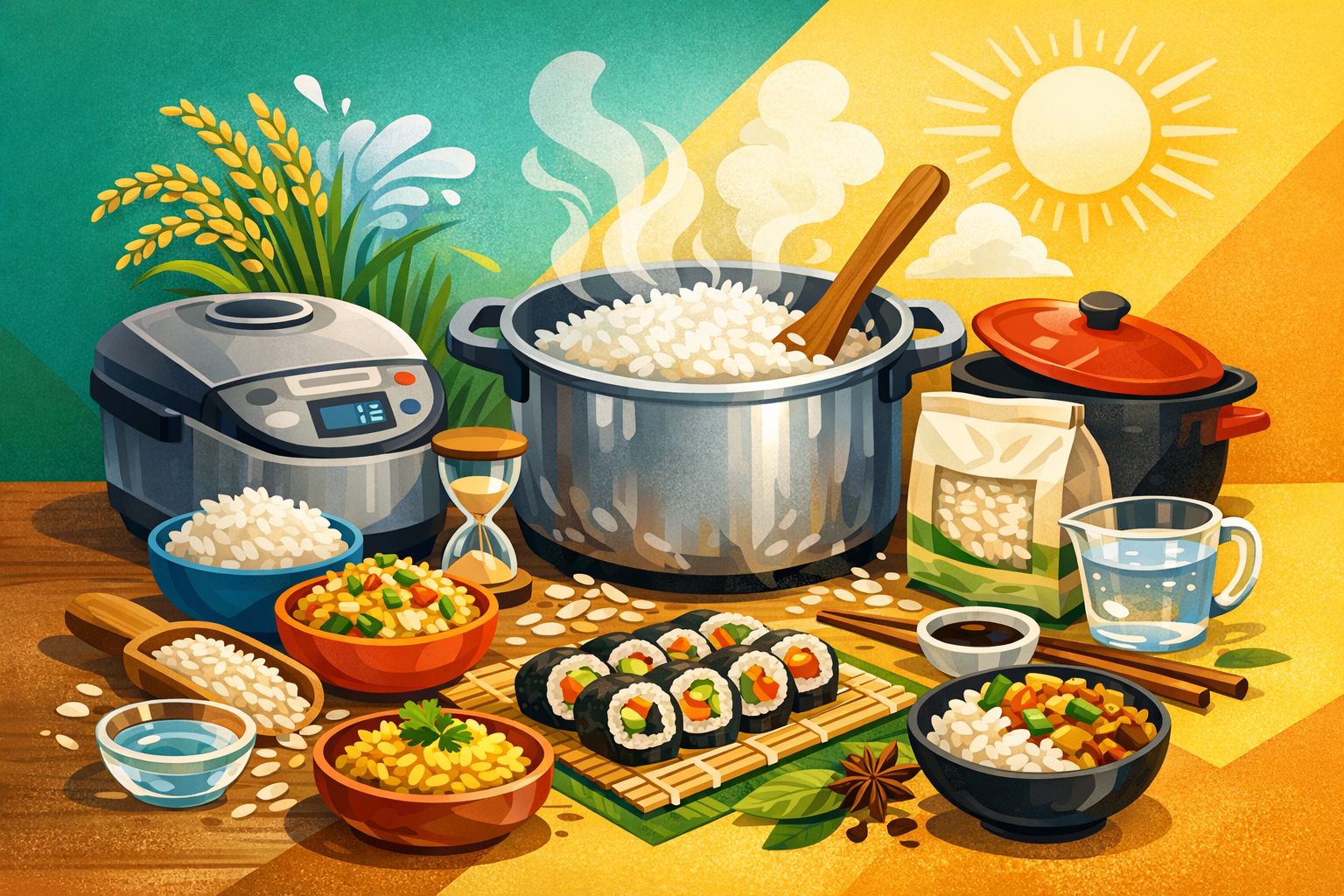
Rice feeds more than half the world's population every single day, yet it remains one of the foods that home cooks most frequently get wrong. Mushy, gummy, crunchy in the center, stuck to the pot in a cement-like layer. These failures happen because most people treat rice as a simple ingredient when it's actually a remarkably complex grain that responds differently depending on the variety, the ratio of water, the cooking method, and even the altitude of your kitchen.
This guide will walk you through the science of rice cookery so you can handle any variety with confidence. Whether you're making fluffy basmati for a curry, sticky sushi rice for homemade rolls, or creamy arborio for risotto, the principles are the same. Once you understand them, you'll never need to measure water with the "finger trick" again (though we'll explain why that trick works, too).
Understanding Rice Varieties
All rice starts as the same basic grain, but the balance of two types of starch inside determines everything about how it cooks and tastes. Those starches are amylose and amylopectin.
Amylose is a long, straight-chain starch molecule. Grains high in amylose cook up fluffy, with individual grains that separate easily. Think long-grain varieties like basmati, jasmine, and Carolina long-grain. These typically contain 20 to 25 percent amylose.
Amylopectin is a branched starch molecule that creates stickiness when hydrated. Short-grain varieties like sushi rice, arborio, and glutinous (sticky) rice are high in amylopectin and lower in amylose. Glutinous rice can have as little as 1 percent amylose, which is why it clumps together so dramatically.
Medium-grain rice (like Calrose, commonly sold in the US) falls somewhere in the middle. It's versatile enough for everyday cooking but won't achieve the extreme fluffiness of basmati or the extreme stickiness of true glutinous rice.
A Quick Variety Guide
Basmati: Grown primarily in India and Pakistan. The grains are extraordinarily long and slender, and they elongate further during cooking (sometimes doubling in length). Aged basmati is prized because the drying process reduces surface moisture, leading to even more separate, fluffy grains. Best for pilafs, biryanis, and alongside curries.
Jasmine: Grown in Thailand, Cambodia, and Vietnam. Slightly shorter and plumper than basmati, with a naturally floral aroma that comes from the compound 2-acetyl-1-pyrroline (the same molecule responsible for the smell of pandan leaves and fresh bread). Cooks up soft and slightly clingy but not truly sticky.
Arborio and Carnaroli: Italian short-grain varieties with a high amylopectin content and a large, starchy core. When stirred constantly during cooking, the outer starch sloughs off and creates the creamy sauce that defines risotto. Carnaroli is considered superior because it maintains a firmer bite in the center.
Sushi rice (Calrose or Koshihikari): Japanese short-grain rice that cooks up sticky enough to hold together when shaped but retains individual grain identity. The stickiness is enhanced by seasoning with rice vinegar, sugar, and salt while the rice is still hot.
Glutinous (sticky) rice: Despite the name, this rice contains no gluten. It's called glutinous because of its extremely sticky, glue-like texture when cooked. Used throughout Southeast Asia for desserts (mango sticky rice) and savory dishes. Must be soaked for several hours and is traditionally steamed, not boiled.
Brown rice: Any variety of rice with the bran layer still intact. The bran adds fiber, B vitamins, and minerals but also creates a barrier that slows water absorption. This is why brown rice takes roughly twice as long to cook as white rice of the same variety.
Why Rinsing Matters (And When to Skip It)
Rinsing rice before cooking is one of those steps people either swear by or skip entirely. The science gives a clear answer: for most applications, rinsing makes a noticeable difference.
When rice is milled, the process creates a fine layer of loose starch powder on the surface of each grain. If you cook without rinsing, that excess starch dissolves into the cooking water and creates a thick, starchy paste that glues the grains together. This is why unrinsed rice turns gummy.
Rinsing under cold running water (or swishing in a bowl, changing the water 3 to 4 times until it runs mostly clear) removes that surface starch. The result is rice with distinct, separated grains that don't clump into a sticky mass.
When to skip rinsing
There are legitimate reasons not to rinse. If you're making risotto, you want that loose surface starch because it's what creates the creamy consistency. Rinsing arborio before making risotto would actively undermine the dish. Similarly, if you're cooking glutinous rice for sticky rice dishes, rinsing is minimal because you want maximum stickiness.
In the United States, white rice is often enriched with iron, niacin, thiamin, and folic acid. These nutrients are sprayed onto the grain surface after milling, and rinsing washes some of them away. If enriched rice is your primary source of these nutrients, this is worth considering. In practice, most people eating a varied diet won't notice the nutritional difference.
The Absorption Method: How Most of the World Cooks Rice
The absorption method is exactly what it sounds like: you add a measured amount of water to a measured amount of rice, bring it to a simmer, cover the pot, and let the rice absorb all the liquid. When the water is gone, the rice is done.
This method works because you're providing exactly enough water for the starch granules to fully hydrate and swell. Too little water and the grains stay hard in the center. Too much and you get overhydrated, mushy rice.
Getting the Ratio Right
Here's where most recipes fail you, because there is no single universal water-to-rice ratio. The correct amount of water depends on the variety, the age of the rice (older rice is drier and needs more water), and even your altitude. But these guidelines will get you very close:
Long-grain white rice (basmati, jasmine): 1.25 to 1.5 cups water per 1 cup rice. Aged basmati leans toward 1.5; fresh jasmine is closer to 1.25.
Medium-grain white rice (Calrose): 1.25 cups water per 1 cup rice.
Short-grain white rice (sushi rice): 1.1 to 1.2 cups water per 1 cup rice.
Brown rice (any variety): 1.75 to 2 cups water per 1 cup rice.
Wild rice: 3 cups water per 1 cup rice (wild rice isn't technically rice; it's a grass seed with a very tough outer hull).
These ratios assume rinsed rice. If you don't rinse, you may need slightly less water because the surface starch thickens the cooking liquid.
The Finger Method
The famous trick where you rest the tip of your index finger on the surface of the rice and add water until it reaches the first knuckle actually works reasonably well for medium and short-grain rice cooked in a flat-bottomed pot. The science is simple: the distance from your fingertip to the first knuckle is roughly 1 inch, and that 1 inch of water above the rice level provides approximately the right amount of extra water for these varieties. It doesn't work as well for long-grain rice (which needs more water) or for very wide pots (where the same depth of water represents a greater total volume).
Step-by-Step Absorption Method
- Rinse the rice in cold water until the water runs mostly clear (3 to 4 changes for white rice).
- Combine rice and the appropriate amount of cold water in a heavy-bottomed pot with a tight-fitting lid.
- Bring to a boil over high heat. You'll see large bubbles and steam.
- Immediately reduce to the lowest possible heat. Cover tightly and do not lift the lid. Set a timer.
- Cook for 15 minutes (white rice) or 40 to 45 minutes (brown rice).
- Remove from heat and let rest, still covered, for 10 minutes. This allows residual steam to finish hydrating the grains evenly.
- Fluff with a fork or rice paddle. Never stir with a spoon; this compresses and breaks the grains.
The "don't lift the lid" rule exists because steam is doing most of the cooking during the final minutes. Each time you lift the lid, you release steam and drop the temperature, which can leave you with undercooked rice.
The Pasta Method: An Underrated Alternative
The pasta method (also called the boiling method) involves cooking rice in a large amount of water, like pasta, then draining it when done. This approach is traditional in parts of South Asia and is experiencing a renaissance among home cooks for good reason.
Bring a large pot of salted water to a rolling boil (think the same volume you'd use for spaghetti). Add the rice and boil uncovered, stirring occasionally, until the grains are tender but still have a slight bite. For white rice this takes about 10 to 12 minutes. Drain in a fine-mesh strainer, return to the pot, cover, and let steam for 5 minutes.
The advantages are significant. First, you never need to worry about water ratios because the excess gets drained away. Second, the vigorous boiling keeps grains moving so they don't stick together. Third, this method actually removes some of the surface starch, resulting in remarkably fluffy, separate grains.
There's an additional benefit that's received attention from researchers: the pasta method has been shown to reduce the arsenic content of rice by up to 50 percent. Rice absorbs arsenic from soil and water during growth, and boiling in excess water allows some of that arsenic to leach out. For people who eat rice daily, this is a meaningful health consideration.
The downside? You lose some water-soluble nutrients (the same enrichment vitamins mentioned earlier) and the cooking water carries away a bit of starch that contributes to flavor. For delicate varieties like jasmine, where the natural aroma is part of the appeal, the absorption method preserves more of those volatile flavor compounds.
Common Mistakes and Fixes
Mushy, gummy rice
Usually caused by too much water, not rinsing, or stirring during cooking. The fix: reduce water by 2 tablespoons per cup of rice, rinse thoroughly, and keep the lid on without stirring.Crunchy, undercooked center
Not enough water, heat too high (water evaporated before the grains hydrated), or the lid wasn't tight enough. Fix: add 2 tablespoons of water, re-cover, and cook on the lowest heat for another 5 minutes. A damp kitchen towel placed between the pot and the lid creates a tighter seal.Scorched bottom
Heat too high after the initial boil. The goal is the absolute lowest flame your stove can produce. If your stove runs hot, a heat diffuser (a flat metal disc that sits between the burner and the pot) is inexpensive and solves the problem completely. Some scorching on the bottom is actually desirable in certain cuisines: the crispy rice layer is called "tahdig" in Persian cooking and "socarrat" in Spanish paella.Bland rice
Rice should always be seasoned. At minimum, salt the cooking water (about 1/2 teaspoon per cup of rice). For more flavor, toast the dry rice in a tablespoon of butter or oil for 2 minutes before adding water. This is the foundation of pilaf-style cooking, and it adds a nutty depth that unseasoned rice simply can't match. Bay leaves, cardamom pods, star anise, or a strip of kombu added to the cooking water also infuse subtle background flavor.Storing and Reheating
Cooked rice is one of the more common sources of foodborne illness, and it's worth understanding why. Uncooked rice can harbor spores of Bacillus cereus, a bacterium that survives boiling. When cooked rice sits at room temperature, those spores germinate and produce a heat-resistant toxin that reheating won't destroy. The solution is straightforward: cool leftover rice quickly (spread it on a sheet pan for fastest cooling), refrigerate within one hour, and use it within 3 to 4 days.
Frozen rice keeps for up to 6 months and reheats remarkably well. The best method: portion into single servings in freezer bags, flatten them thin, and freeze. To reheat, sprinkle a tablespoon of water over the frozen rice, cover loosely, and microwave for 2 minutes. The small amount of added water creates steam that re-hydrates the grain surfaces without making them soggy.
Day-old refrigerated rice is actually ideal for fried rice. The overnight rest in the fridge dries the grain surfaces and retrograded starch (starch that has re-crystallized during cooling) gives the grains more structural integrity. This is why freshly cooked rice turns to mush in a wok while yesterday's rice gets perfectly crispy and separate.
Beyond White and Brown: Specialty Rices Worth Trying
If you've only ever cooked long-grain white and basic brown rice, there's a world of flavors and textures waiting.
Black rice (forbidden rice): Deep purple-black color from anthocyanin pigments (the same antioxidants found in blueberries). Slightly nutty, with a chewier texture than white rice. Cooks in about 30 minutes using the absorption method with a 1.75:1 water ratio.
Red rice (Bhutanese or Thai): Earthy, slightly sweet flavor with a firm, satisfying chew. The intact bran layer gives it more fiber than white rice. Excellent in grain bowls and salads because it holds its shape well.
Bomba rice: Spanish short-grain rice used in paella. Absorbs nearly three times its volume in liquid (compared to about two times for most varieties), which allows it to soak up deeply flavored stock while remaining firm. This absorbency is what makes authentic paella so intensely flavorful.
Rice is one of those ingredients that rewards curiosity. Each variety has its own personality, its own ideal cooking method, and its own place in the kitchen. Master the fundamentals of starch behavior, water ratios, and heat management, and you'll never open a box of instant rice again.